
Most Silicon Doesn’t Work the Way You Think It Does
Silicon is abundant in soil — and widely used in agriculture.
But plant response depends on availability, not presence.
MaxSil focuses on Plant Available Silicon (PAS) — the form plants can actually absorb — and how that changes nutrient efficiency, stress response, and yield consistency.
The Problem Isn’t Silicon. It’s Availability.
Most soils already contain large amounts of silicon.
Many products also report high silicon content.
But in both cases, the majority exists in forms plants cannot absorb.
So the question isn’t:
“Is silicon present?”
It’s:
“Is it available to the plant when it needs it?”
What Plants Actually Use
Plants absorb silicon only as monosilicic acid (Si(OH)₄). This is referred to as Plant Available Silicon (PAS).
Independent testing shows MaxSil delivers >36,000 ppm PAS, significantly higher than most silicon sources.
This is not a difference in quantity. It’s a difference in function.
Why Silicon Has Produced Mixed Results Historically
Silicon has been trialled for decades — with inconsistent outcomes.
Not because it doesn’t work — but because most materials:
are not plant-available
require long conversion in soil
or never become available within the crop cycle
So results vary — not because the concept is flawed — but because availability is inconsistent.
When Availability Changes, System Performance Changes
Plant Response
stronger structural integrity
improved stress tolerance
more efficient nutrient uptake
System Effect
improved input efficiency
more consistent performance
reduced dependency on increasing inputs
The effect is not isolated — it’s systemic.
Why This Matters Commercially
In many systems, the limitation is no longer input volume — it’s how efficiently those inputs are converted into yield.
Fertiliser efficiency improvements
Reduced nutrient loss
More stable performance under stress
This shifts the focus from adding more to getting more from what’s already there.
Designed to Work Within Existing Systems
MaxSil integrates into existing programs without requiring new infrastructure.
Compatible with standard fertiliser blends
Can be applied via seed coating, liquid systems, or granules
No specialised equipment required
This allows integration without disrupting established operations.
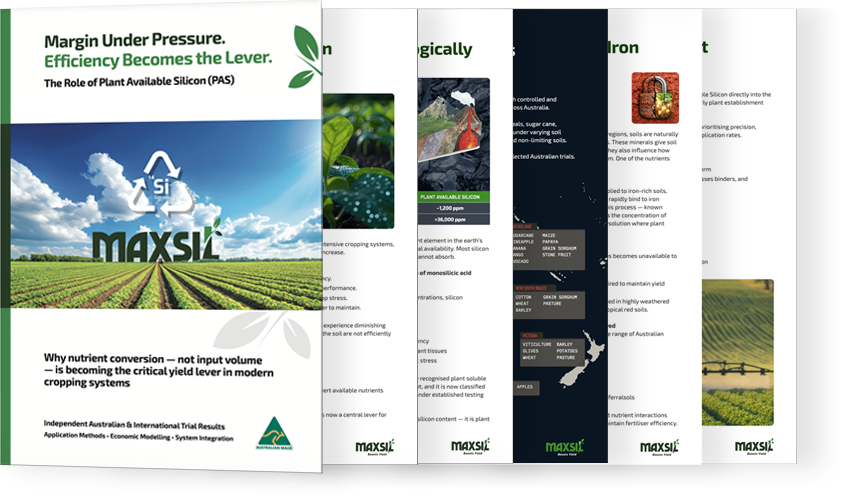
Independent trials, system integration, and economic modelling across Australian conditions.
Most Programs Are Losing Efficiency in Three Places
Phosphorus Lock-Up
Large portions of applied P become unavailable in soil
→ Existing nutrient investment underutilised
Nitrogen Loss
Up to 10–40% of nitrogen can be lost under typical conditions
→ Reduced efficiency of applied inputs
Global Input Exposure
Fertiliser pricing tied to global supply chains
→ volatility in cost per hectare
Improving efficiency reduces dependence on all three.
How This Shows Up in the Field
Broadacre
Improving input efficiency and yield reliability at scale
→ Focus on cereals and large-acre systems.
View Broadacre →
Horticulture
Supporting plant strength, fruit quality, and consistency
→ Particularly in high-input systems
View Horticulture →
Tree Crops
Protecting long-term productivity of permanent plantings
→ Structural support across seasons
View Tree Crops →
Backed by Commercial Trials and Ongoing Research
MaxSil has been tested across a range of soil types, crops, and conditions — including saline and acidic environments.
Trial work focuses on:
yield outcomes
input efficiency
plant response under stress
View Research →
Independent trials, system integration, and economic modelling across Australian conditions.


