When Inputs Rise, Efficiency Becomes the Most Valuable Input.
Watch how growers are responding to input volatility
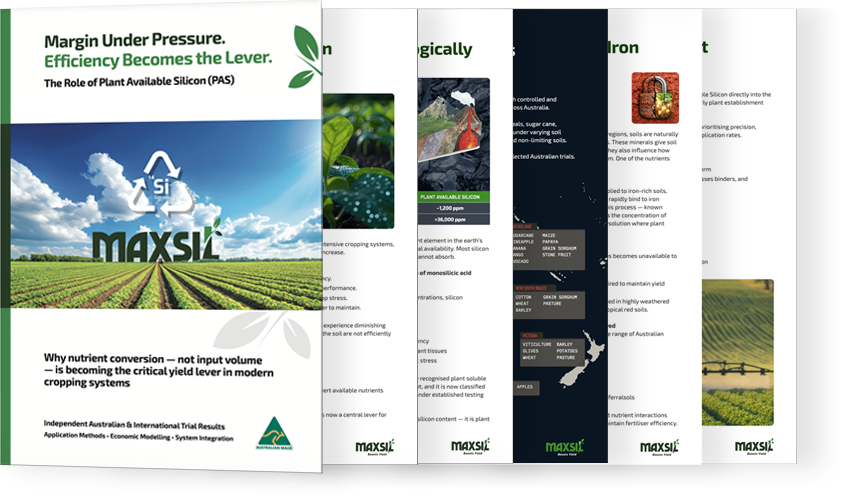
Short Technical Briefing
The Efficiency Challenge in Modern Cropping
Across modern cropping systems, margin pressure is no longer cyclical — it is structural.
Nutrients may be present in the soil. But if they are not effectively converted into plant growth, yield potential is left unrealised.
The question is no longer:
“How much fertiliser do I apply?”
It is:
“How efficiently can the plant convert available nutrients into yield?”
When inputs become volatile, this becomes the most important lever on the farm.
You Can’t Control Global Markets.
But You Can Control Efficiency Per Hectare.
Fuel moves.
Fertiliser moves.
Freight moves.
But growers still have two powerful levers:
Nutrient Efficiency
Crop Performance
The Role of Plant Available Silicon (PAS)
Silicon is abundant in soil — but availability, not abundance, determines plant response.
Only soluble silicon — Plant Available Silicon (PAS) — can be absorbed by plants.
When delivered in plant-available form, silicon has been shown to:
Support nutrient uptake efficiency
Improve structural strength
Enhance stress tolerance
Contribute to crop performance
This is where efficiency gains begin to translate into real outcomes in the field.
Two Levers That Matter in Volatile Seasons
Drive Input Costs Down
Nutrient Uptake Efficiency
Drive Profit Curves Up
Yield • Crop Quality • Marketable Produce
When efficiency improves, input pressure falls — and yield potential rises.
What This Means Economically
Improving nutrient conversion is not theoretical — it must translate into measurable return per hectare.
Field trials indicate yield improvements across multiple cropping systems, alongside potential reductions in NPK reliance under managed programs.